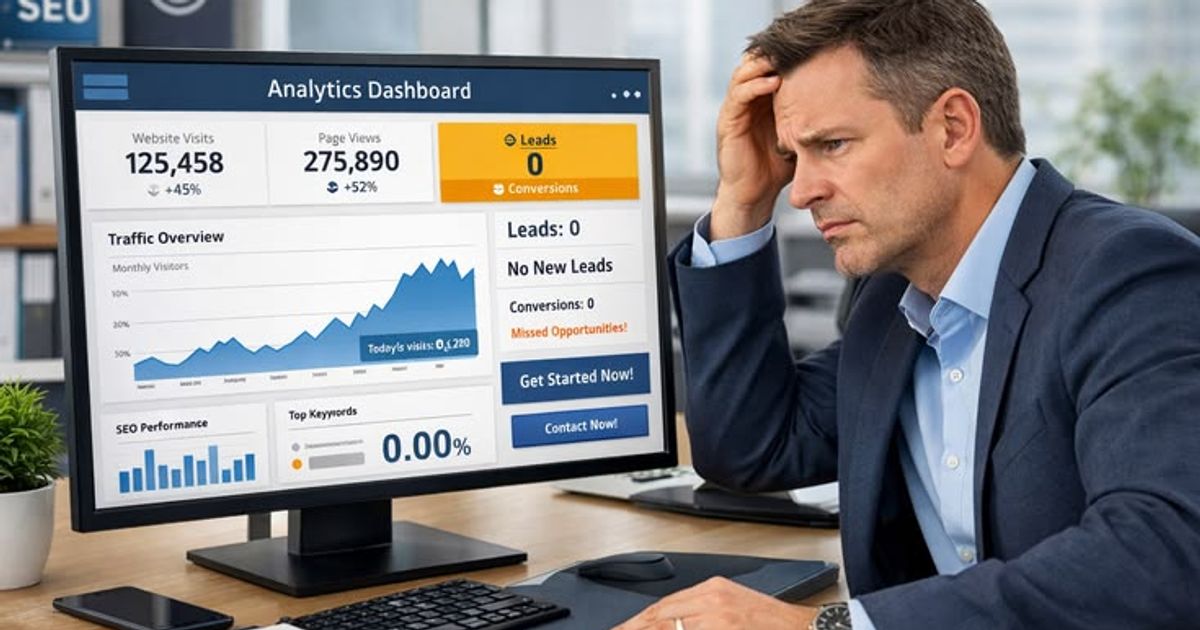
Many businesses assume that if their website is receiving traffic, it must be generating opportunities.
Unfortunately, that's not always true.
A website can attract hundreds or even thousands of visitors each month while quietly losing potential customers before they ever submit a form, make a call, or request a quote.
The challenge is that these lost opportunities often go unnoticed.
Visitors rarely tell you why they leave.
They simply click away and choose a competitor.
If your website isn't converting visitors into inquiries, leads, or customers, there are usually warning signs hiding in plain sight.
Here are 10 signs your website may be losing potential customers before they contact you.
1. Your website loads slowly
Website speed directly impacts user experience.
Modern users expect pages to load almost instantly. When pages take too long to load, visitors often leave before engaging with your content.
Slow websites commonly suffer from:
- Large image files
- Excessive scripts
- Poor hosting environments
- Unoptimized code
Even a few seconds of delay can significantly reduce conversion rates.
Fast websites create better experiences and keep visitors engaged longer.
2. Your bounce rate is extremely high
A high bounce rate often indicates visitors are not finding what they expected.
While bounce rate varies by industry and page type, consistently high numbers can suggest issues such as:
- Poor content relevance
- Weak user experience
- Slow loading times
- Misaligned search intent
When visitors leave without exploring additional pages, potential business opportunities are being lost.
3. Your website isn't mobile-friendly
Mobile traffic now accounts for a significant share of website visits.
If your website performs poorly on smartphones and tablets, users may struggle with:
- Navigation
- Readability
- Forms
- Page speed
- Interactive elements
A poor mobile experience can quickly drive potential customers away.
This is one reason businesses often work with a professional search optimisation agency to ensure websites perform effectively across all devices.
4. Your calls-to-action are weak or unclear
Visitors should immediately understand the next step they need to take.
Unfortunately, many websites hide or dilute their calls to action.
Examples include:
- Generic buttons
- Confusing messaging
- Multiple competing actions
- Hard-to-find contact options
When users are unsure what to do next, they often do nothing.
Clear calls to action help guide visitors toward conversion.
5. You lack trust signals
Trust plays a major role in purchasing decisions.
Visitors often look for proof before contacting a business.
Important trust signals include:
- Client testimonials
- Reviews
- Certifications
- Awards
- Case studies
- Industry experience
Without these credibility indicators, visitors may hesitate to engage with your company.
6. Your content doesn't answer customer questions
Many websites focus heavily on describing services while ignoring customer concerns.
Potential buyers often want answers to questions such as:
- How does the process work?
- What results can I expect?
- How long does implementation take?
- Why should I choose your company?
Businesses offering strong educational content generally create more trust and engagement than websites that focus solely on self-promotion.
7. Navigation is difficult to use
Visitors should be able to find information quickly.
Complicated navigation often creates frustration and increases abandonment rates.
Common navigation issues include:
- Too many menu items
- Poor page hierarchy
- Broken links
- Confusing layouts
A simple and intuitive structure improves user experience and increases the likelihood of conversions.
Many organizations seeking long-term growth partner with a specialized company for seo to improve both search visibility and website usability.
8. You receive traffic but few leads
This is one of the clearest warning signs.
If traffic continues growing while inquiries remain stagnant, your website likely has conversion issues.
Possible causes include:
- Weak messaging
- Poor landing pages
- Technical issues
- User experience problems
- Lack of trust signals
Traffic alone does not generate revenue.
Conversions do.
Analyzing visitor behavior can reveal where prospects are dropping off before contacting your business.
9. Your website doesn't support multiple marketing channels
Modern customers often discover businesses through multiple touchpoints before converting.
These channels may include:
- Organic search
- Social media
- Email marketing
- Paid advertising
- Referral traffic
Businesses investing in digital marketing services understand the importance of creating consistent user experiences across every channel.
When website messaging and user journeys are disconnected, conversion opportunities are often lost.
10. Your competitors offer better experiences
Sometimes the biggest problem is not your website itself.
It is your competitors.
Visitors frequently compare multiple businesses before making a decision.
If competing websites provide:
- Better content
- Faster performance
- Stronger trust signals
- Easier navigation
- Clearer messaging
They are more likely to win the customer.
Businesses running campaigns through a professional PPC Agency or investing in e-commerce often gain competitive advantages by continuously optimizing their customer experience.
The companies that convert best are usually the ones that make buying decisions easier.
Why small website problems create big revenue losses
Many businesses underestimate the financial impact of website issues.
Even small improvements can generate substantial gains.
For example:
- Faster page speed improves engagement.
- Better calls-to-action increase inquiries.
- Stronger trust signals improve conversions.
- Improved mobile experiences reduce abandonment.
When these optimizations work together, lead generation and revenue often increase significantly.
The challenge is identifying hidden friction before it affects business growth.
Why conversion optimization matters more than ever
Today's customers have endless options.
If a website creates confusion, frustration, or uncertainty, visitors can leave and find alternatives within seconds.
This makes website optimization essential for modern businesses.
Companies that focus on:
- User experience
- Conversion optimization
- Technical performance
- Content quality
- Trust building
typically generate more value from their existing traffic.
Rather than simply attracting more visitors, they maximize the value of every visitor already arriving on the site.
Conclusion
A website should function as a lead-generation and revenue-generation asset.
If visitors are leaving without contacting your business, there is usually a reason.
Slow performance, poor mobile experiences, weak messaging, lack of trust signals, confusing navigation, and conversion barriers can quietly cost businesses significant opportunities.
The good news is that most of these issues can be identified and corrected.
Businesses that regularly evaluate user experience and optimize for conversions are better positioned to turn website visitors into customers and create sustainable long-term growth.
Author Bio
Haniel Singh is the Founder and CEO of RankSpark, an AI-driven SEO and digital marketing agency specializing in technical SEO, conversion optimization, content strategy, AI search visibility, and performance marketing. Since 2012, Haniel has helped businesses improve online visibility, increase qualified leads, and build scalable digital growth systems that drive measurable business results.
Frequently Asked Questions
1. Why do visitors leave websites without converting?
Visitors often leave because of slow loading speeds, poor user experience, unclear messaging, lack of trust signals, or difficulty finding information.
2. How can I tell if my website has conversion problems?
Common signs include high bounce rates, low lead generation, poor engagement metrics, short session durations, and high exit rates on important pages.
3. Does website speed affect conversions?
Yes. Faster websites provide better user experiences and typically generate higher engagement and conversion rates than slower websites.
4. Why is mobile optimization important?
A significant percentage of website traffic comes from mobile devices. Poor mobile experiences often lead to higher abandonment rates and lost sales opportunities.
5. What are trust signals on a website?
Trust signals include testimonials, reviews, certifications, awards, case studies, security badges, and social proof that help build visitor confidence.
6. How do calls-to-action impact lead generation?
Calls-to-action guide visitors toward desired actions such as contacting your business, requesting a quote, or making a purchase. Weak CTAs often reduce conversions.
7. Can high traffic still result in low sales?
Yes. Traffic alone does not guarantee revenue. If visitors encounter friction during their journey, they may leave without converting.
8. What is the biggest reason websites lose potential customers?
The most common reason is poor user experience. Visitors expect websites to be fast, trustworthy, easy to navigate, and relevant to their needs.