If you're planning your marketing budget for 2026, one question will almost certainly come up:
Should you invest in SEO or Google Ads?
For years, businesses have viewed these channels as competing options. SEO was considered a long-term investment, while Google Ads was seen as the fast track to leads and sales.
But in today's AI-driven search landscape, that comparison is no longer as simple.
Google Search now combines organic listings, AI Overviews, Shopping results, Local Packs, and paid advertisements on a single results page. At the same time, customer journeys have become longer and more fragmented. A buyer may discover your business through an AI-generated answer, return through an organic search, and finally convert after clicking a Google Ad.
The question isn't whether SEO or Google Ads works.
The real question is which delivers better return on investment for your business based on your goals, budget, timeline, and industry.
Let's break it down.
Understanding the difference between SEO and Google Ads
Although both channels help your business appear on Google, they operate very differently.
SEO focuses on improving your website so it earns organic visibility over time. This involves technical optimization, high-quality content, authority building, user experience, and increasingly, AI-focused optimization for modern search.
Google Ads, on the other hand, allows businesses to bid for visibility. You pay whenever someone clicks your advertisement, making it an effective way to generate immediate traffic.
One strategy builds long-term digital assets.
The other rents visibility as long as your advertising budget remains active.
Understanding this difference is essential before deciding where to invest.
When Google Ads makes sense
Google Ads is often the fastest way to generate qualified traffic.
For businesses launching a new product, entering a competitive market, or testing customer demand, paid campaigns provide immediate feedback. You can quickly identify which keywords convert, which messaging resonates, and which audiences are most profitable.
Google Ads is particularly valuable when:
- You need leads immediately.
- Your business is running seasonal promotions.
- You're validating a new service or market.
- Your website already converts visitors effectively.
However, every click comes with a cost.
As competition increases across industries, cost-per-click continues to rise. Once your advertising budget stops, so does your visibility.
Paid advertising creates momentum, but it rarely creates long-term digital equity.
Why SEO delivers compounding ROI
SEO requires patience, but its long-term economics are difficult to ignore.
Unlike paid advertising, organic traffic doesn't disappear when monthly budgets fluctuate. Every optimized page, helpful article, and authoritative backlink becomes a digital asset that continues generating visibility over time.
Modern SEO has evolved far beyond keyword optimization.
Search engines now evaluate:
- Topical authority
- Technical website health
- User experience
- Content quality
- Semantic relevance
- Brand trust
- AI search readiness
Businesses that consistently invest in these areas build sustainable growth instead of relying entirely on paid acquisition.
Over time, SEO often lowers customer acquisition costs while improving brand credibility.
Why AI is changing SEO forever
Search in 2026 isn't limited to traditional Google rankings.
Users increasingly interact with AI-powered search experiences that summarize information, recommend businesses, and answer questions directly.
This shift has given rise to AI SEO services, which focus on optimizing websites for both search engines and AI-driven discovery platforms.
Rather than targeting keywords alone, AI-focused SEO emphasizes semantic structure, entity optimization, topical expertise, and content that machines can easily interpret.
Businesses investing in AI-ready SEO today are positioning themselves for future search behavior, not just current rankings.
Choosing the best-rated SEO services for sustainable growth
Many businesses struggle with SEO because they treat it as a checklist instead of a long-term strategy.
Working with the best-rated SEO services means looking beyond rankings alone. A strategic SEO partner should improve your technical foundation, content ecosystem, authority signals, and conversion performance while preparing your website for AI-driven search.
The strongest SEO campaigns don't simply increase traffic.
They attract visitors who are more likely to become customers.
Why performance marketing services complement SEO
SEO and paid advertising perform best when they support one another.
This is where performance marketing services become valuable.
Instead of treating organic and paid channels separately, performance marketing aligns search, paid media, landing pages, analytics, and conversion optimization into one growth strategy.
For example, Google Ads data can reveal high-converting keywords that inform your SEO strategy. At the same time, strong organic rankings reduce dependency on paid campaigns for those same search terms.
Together, these channels create a more balanced customer acquisition model.
The role of a performance marketing agency in 2026
As digital marketing becomes increasingly data-driven, businesses are looking for partners who understand the entire customer journey.
A modern performance marketing agency doesn't focus solely on ad spend or rankings.
Instead, it evaluates:
- Customer acquisition cost
- Lifetime customer value
- Conversion rates
- Organic visibility
- Paid campaign efficiency
- Attribution across multiple channels
This holistic approach ensures marketing investments generate measurable business outcomes rather than isolated vanity metrics.
Why businesses look for great SEO companies
Not every SEO provider delivers the same level of expertise.
Many agencies still rely on outdated tactics that focus heavily on keyword density and backlink quantity.
The great SEO companies operating in 2026 prioritize technical excellence, user experience, AI search optimization, content strategy, and measurable business growth.
When evaluating an SEO partner, businesses should ask how they approach AI search, entity optimization, technical audits, and long-term authority building, not just keyword rankings.
Those capabilities will become increasingly important as search continues evolving.
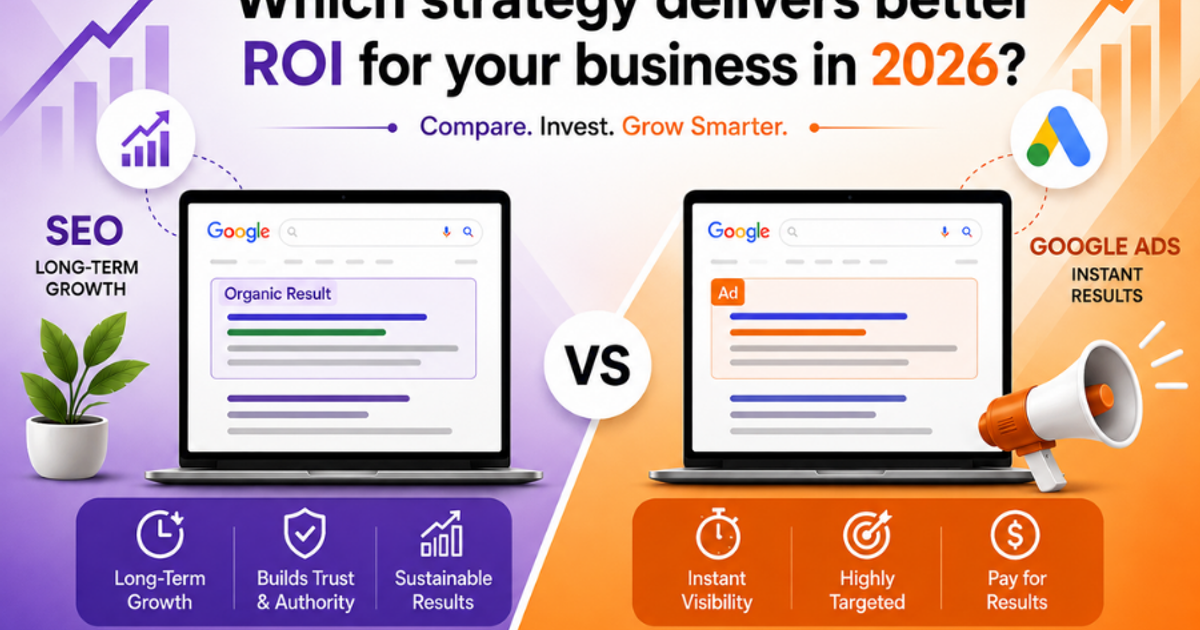
What delivers better ROI in 2026?
The answer depends on your objectives.
If your business needs immediate leads, Google Ads often provides faster results.
If your goal is sustainable visibility, lower acquisition costs, and long-term growth, SEO usually delivers stronger returns over time.
For most businesses, the highest ROI doesn't come from choosing one channel over the other.
It comes from using each channel for its strengths.
Paid advertising creates immediate opportunities.
SEO builds long-term momentum.
Together, they create a marketing engine that's more resilient than relying on either strategy alone.
Finding the best SEO company services for long-term success
Choosing the best SEO company services is about more than comparing prices or guarantees.
The right SEO partner should understand your business goals, industry competition, technical challenges, and evolving search behavior.
Look for an agency that combines technical SEO, AI-driven optimization, content strategy, analytics, and conversion-focused thinking into a single roadmap.
That's how SEO becomes a business investment instead of simply a marketing expense.
How RankSpark helps businesses maximize ROI
At RankSpark, we believe businesses shouldn't have to choose between SEO and paid advertising.
We build integrated growth strategies that combine technical SEO, AI-driven optimization, performance marketing, and conversion optimization to maximize return on every marketing dollar.
Our approach focuses on helping businesses improve visibility across traditional search, AI-powered discovery, and paid acquisition channels while reducing long-term customer acquisition costs.
Because in 2026, the companies achieving the highest ROI aren't investing in isolated tactics.
They're building connected digital growth systems that continue delivering value long after campaigns launch.
If you're ready to improve your marketing ROI, explore RankSpark SEO and performance marketing solutions to build a strategy designed for the future of search.
Author Bio: append to published article
Haniel Singh is the Founder and CEO of RankSpark, an AI-driven SEO and performance marketing agency helping businesses increase visibility, generate qualified leads, and improve long-term ROI through technical SEO, AI search optimization, and data-driven growth strategies. Since 2012, Haniel has worked with startups, eCommerce brands, and enterprise businesses to build scalable digital marketing systems designed for the future of search.
Frequently asked questions
1. Is SEO better than Google Ads in 2026?
SEO generally delivers stronger long-term ROI because organic visibility compounds over time. Google Ads, however, is better suited for businesses needing immediate traffic and lead generation.
2. Should small businesses invest in SEO or paid ads first?
If immediate leads are essential, Google Ads is a practical starting point. Once revenue becomes consistent, investing in SEO helps reduce long-term acquisition costs and creates sustainable growth.
3. Does AI affect SEO?
Yes. AI-driven search experiences are changing how users discover businesses. Modern SEO now includes semantic optimization, entity building, structured content, and strategies that improve visibility in AI-generated search results.
4. Can SEO and Google Ads work together?
Absolutely. Google Ads provides immediate performance insights, while SEO builds long-term authority. Using both channels together often produces better overall ROI than relying on either one independently.