
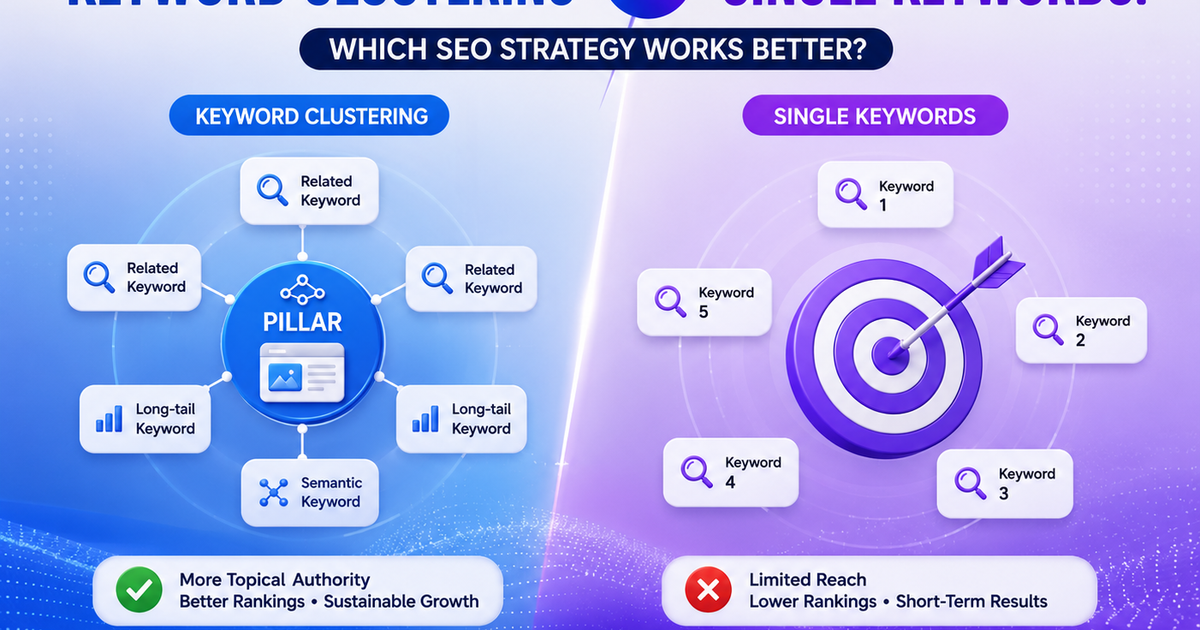
SEO has evolved far beyond optimizing a page for a single keyword. Search engines now understand topics, user intent, and semantic relationships between search queries. This blog explores the differences between keyword clustering and single-keyword targeting, why each approach matters, and which strategy delivers better results in today's search landscape. You'll learn how businesses can use keyword clustering to improve rankings, traffic, and overall SEO performance.
Quick Answer
Keyword clustering is generally a more effective SEO strategy than targeting single keywords alone. By grouping related search terms and optimizing content around a broader topic, businesses can rank for multiple queries, improve search visibility, and better match user intent. While single keywords still have value for specific pages, keyword clustering typically delivers stronger long-term SEO results and greater organic traffic growth.
What is keyword clustering vs. single keywords?
Keyword clustering is the process of grouping related keywords that share similar search intent and optimizing a single page around those terms. Instead of creating separate pages for every keyword variation, businesses create comprehensive content that addresses multiple relevant searches.
Single-keyword targeting focuses on optimizing a page around one primary keyword. This traditional SEO approach was widely used when search engines relied heavily on exact-match keywords to determine rankings.
For example, a business targeting "SEO services" may also optimize for related terms such as SEO consulting, SEO strategy services, enterprise SEO solutions, and local SEO services through keyword clustering. This allows one page to rank for numerous relevant searches instead of only a single phrase.
Modern search engines increasingly favor topic-focused content, making keyword clustering an essential component of successful SEO strategies.
Why is keyword clustering important?
Keyword clustering offers several advantages for businesses looking to improve their search performance.
First, it increases keyword coverage. A single piece of content can rank for dozens or even hundreds of related search terms.
Second, it improves content relevance. Search engines better understand the topic being discussed when related terms and concepts are naturally included throughout the page.
Third, keyword clustering enhances user experience. Visitors receive more comprehensive answers instead of needing to navigate multiple pages to find information.
From a business perspective, clustering reduces content duplication, strengthens topical authority, and improves overall content efficiency.
Many companies investing in top SEO company services use keyword clustering because it helps maximize the ranking potential of every page while supporting broader content marketing goals.
How keyword clustering works in modern SEO
Keyword clustering begins with identifying a core topic and gathering related search terms that share similar intent.
The process typically starts with keyword research tools that reveal variations, questions, and semantically related phrases. These keywords are then grouped based on user intent rather than exact wording.
Once clusters are created, content is developed to address all related queries within a single page. Internal linking further supports the relationship between pages and topic clusters.
Search engines analyze these relationships and recognize the page as a comprehensive resource for the broader subject.
Businesses working with the best search engine optimisation company often use advanced clustering strategies to identify opportunities that competitors may overlook, allowing them to capture additional search visibility without creating unnecessary content.
Why keyword clustering works better in the USA search landscape
Search behavior in the USA continues to become more conversational and intent-driven. Users often search using different phrases that ultimately seek the same information.
Google's algorithms have become highly effective at understanding context, synonyms, and semantic meaning. As a result, creating separate pages for every keyword variation is often unnecessary and can even create keyword cannibalization issues.
Keyword clustering allows businesses to align content with how users naturally search while helping search engines identify the most authoritative page for a topic.
Companies that invest in strong SEO keyword research can uncover valuable keyword clusters that drive highly qualified traffic and improve overall search visibility across competitive markets.
What should businesses know about keyword clustering?
Businesses should understand that effective clustering requires more than simply grouping similar keywords.
The most successful keyword clusters are based on search intent. If users searching different terms expect the same answer, those keywords can often be targeted within a single page.
Content quality remains essential. A page optimized for multiple keywords must still provide clear, valuable, and relevant information.
Internal linking also plays an important role in supporting keyword clusters and helping search engines understand topic relationships.
Regular content audits should be conducted to identify opportunities for consolidation, optimization, and improved topic coverage.
Organizations using managed SEO services frequently benefit from structured clustering strategies because they help scale content creation while maintaining strong topical relevance.
Common challenges or mistakes
One of the most common mistakes is grouping unrelated keywords simply because they contain similar words. Search intent should always guide clustering decisions.
Another issue is over-optimizing content by forcing too many keywords into a page. This can negatively impact readability and user experience.
Many businesses also create separate pages for keywords that share identical intent. This often leads to keyword cannibalization, where multiple pages compete against each other in search results.
Ignoring user intent is another frequent challenge. Even closely related keywords may require separate content if users expect different information.
Finally, some organizations fail to update keyword clusters over time. Search behavior evolves, and content strategies should adapt accordingly.
When should you consider keyword clustering in the USA?
Keyword clustering should be considered whenever businesses want to improve content efficiency, strengthen topical authority, and increase search visibility.
It is particularly valuable for eCommerce brands, SaaS companies, B2B organizations, healthcare providers, law firms, financial services companies, and local businesses competing in crowded markets across the USA.
Businesses launching new content strategies can use clustering to build authority faster, while established organizations can consolidate existing content and improve ranking performance.
As AI-powered search experiences continue to grow, keyword clustering will become even more important because AI systems prioritize comprehensive content that addresses broader topics rather than isolated keyword variations.
Conclusion
Keyword clustering and single-keyword targeting both have roles in SEO, but keyword clustering is generally the stronger long-term strategy. By focusing on topics and user intent rather than individual keywords, businesses can improve rankings, increase search visibility, strengthen topical authority, and attract more qualified traffic. While single keywords remain useful for highly specific searches, modern search engines increasingly reward comprehensive content that addresses related queries within a unified framework. Businesses that embrace keyword clustering are better positioned for sustained growth in both traditional and AI-driven search environments.
Contact RankSpark today and improve your rankings with a smarter keyword clustering strategy.
Frequently asked questions
1. What is keyword clustering in SEO?
Keyword clustering is the process of grouping related keywords with similar search intent and optimizing content around those groups rather than individual keywords.
2. Is keyword clustering better than targeting single keywords?
In most cases, yes. Keyword clustering helps pages rank for multiple search queries, improves topical relevance, and increases opportunities for organic traffic.
3. How many keywords should be in a cluster?
The number varies depending on the topic and search intent. Some clusters may contain five keywords, while others can include dozens of related terms.
4. Can keyword clustering improve topical authority?
Yes. Keyword clustering helps create comprehensive content that demonstrates expertise and strengthens topical authority within a subject area.
5. Does keyword clustering help AI search results?
Yes. AI-powered search systems favor content that covers topics comprehensively, making keyword clustering beneficial for AI search visibility.
6. How often should keyword clusters be updated?
Businesses should review keyword clusters regularly, typically every six to twelve months, to align with changing search trends and user behavior.