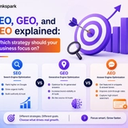
The future of SEO in 2026 is no longer about ranking pages alone. It’s about becoming the source AI engines choose to trust, summarize, and recommend. Traditional search visibility is shifting toward AI-generated answers, conversational discovery, and predictive search experiences. Brands that adapt to Generative Engine Optimization (GEO) are already gaining visibility within AI-driven platforms, while competitors continue to optimize only for blue links.
For years, SEO revolved around rankings, keywords, backlinks, and technical structure. Those fundamentals still matter, but the layer above them has changed. Search engines are increasingly becoming answer engines. Instead of presenting ten links and asking users to choose, AI systems now synthesize information directly into summaries, recommendations, comparisons, and generated responses.
That changes everything about how content earns visibility.
A page no longer competes only for a position in search results. It competes to become the source material AI systems draw on when generating answers.
The businesses winning in 2026 understand that visibility now happens across multiple environments simultaneously: Google AI Overviews, conversational AI platforms, voice search systems, AI shopping assistants, and predictive discovery engines. SEO has evolved from search engine optimization into search presence optimization.
And the shift is happening faster than most companies realize.
Why traditional SEO alone is no longer enough
Most businesses are still operating with a 2020 SEO mindset inside a 2026 search ecosystem.
They publish keyword-focused articles, build backlinks, improve Core Web Vitals, and expect rankings to translate directly into traffic growth. But the structure of search behavior itself has changed. Users increasingly receive answers before clicking. AI-generated summaries absorb informational intent directly inside search interfaces.
That means organic visibility is no longer measured only through clicks.
Brands now need to optimize for citation, recommendation, topical authority, contextual trust, and AI retrieval relevance.
The biggest misconception about AI search is that it replaces SEO. It doesn’t. AI systems still rely heavily on traditional SEO foundations because they need structured, crawlable, authoritative information sources. Technical SEO, schema markup, site architecture, and semantic relevance matter more now—not less.
But the objective has changed.
Instead of optimizing purely for ranking position, brands must optimize for inclusion within AI-generated responses.
This is where Generative Engine Optimization enters the picture.
What is Generative Engine Optimization (GEO)?
Generative Engine Optimization (GEO) is the process of structuring content, authority signals, and website architecture so AI systems can retrieve, understand, trust, and reference your information inside generated answers.
Traditional SEO optimized for search engine rankings.
GEO optimizes for AI interpretation.
That difference sounds subtle, but operationally, it changes content strategy completely.
AI systems don’t evaluate pages the same way humans scan SERPs. They prioritize clarity, contextual relationships, authority consistency, semantic depth, entity recognition, factual reliability, and content structure. Pages designed only around keywords often fail in AI retrieval systems because they lack contextual completeness.
The sites performing best in AI search environments are usually the ones that:
- Demonstrate deep topical authority instead of isolated keyword targeting
- Structure information clearly with contextual relationships and semantic hierarchy
- Maintain consistent expertise signals across authors, entities, and brand mentions
- Publish original insights rather than rewritten summaries of existing content
This is why many websites with strong traditional rankings still struggle to appear inside AI-generated search experiences. Their SEO strategy was built for indexing, not synthesis.
AI search is changing user behavior faster than mobile ever did
The transition toward AI-driven discovery is happening faster than the mobile search transition because the behavioral friction is lower.
Users don’t need to learn something new. They simply ask questions naturally.
Search is becoming conversational, iterative, and intent-compressed.
Instead of searching: “best CRM software for startups.”
Users now ask:
“What’s the best CRM for a 10-person SaaS company with a limited budget and remote sales team?”
That query carries layered intent, context, constraints, and expectations.
AI systems process those relationships better than traditional search engines because they understand semantic meaning beyond keywords.
This has major implications for content strategy.
Pages optimized around rigid exact-match keyword structures increasingly lose relevance compared to content that fully addresses contextual user intent. Thin SEO pages built around volume metrics struggle because AI systems reward comprehensive topical coverage instead of isolated optimization.
In practical terms, the future of SEO belongs to brands that answer problems comprehensively, not brands that publish the highest quantity of content.
The rise of entity-based SEO
One of the biggest shifts happening beneath AI search is the movement toward entity-based understanding.
Search engines increasingly identify relationships between people, companies, products, services, industries, and topics instead of relying primarily on keywords.
An entity is not just a phrase. It’s a recognized concept with contextual meaning.
For example, AI systems understand that RankSpark is connected to SEO, digital marketing, AI search optimization, GEO strategy, technical SEO, content marketing, and performance growth. Those relationships become part of the brand’s search identity.
This is why brand authority matters more in 2026 than ever before.
AI systems prefer citing recognizable, consistent, authoritative entities because trust matters in generated responses. Anonymous, generic content struggles to earn visibility when AI systems evaluate reliability signals across the web.
Brands building strong entity relationships through:
- consistent publishing
- authoritative mentions
- expert authorship
- digital PR
- structured data
- topical specialization
We are creating long-term AI visibility advantages that competitors cannot easily replicate.
The future SEO battlefield is no longer keyword density. It’s knowledge graph positioning.
Why content quality standards are becoming ruthless
AI-generated content flooded the internet over the last few years. Most of it added little value.
As a result, search systems became significantly more aggressive in evaluating originality, expertise, and usefulness.
In 2026, average content performs worse than ever.
The internet already contains enough rewritten summaries. AI engines don’t need another recycled article saying the same thing as everyone else. They prioritize unique insight, proprietary experience, data-backed perspectives, expert interpretation, and first-hand knowledge.
This is why many businesses publishing high volumes of AI-written content are seeing declining organic performance despite increasing output.
Volume stopped being the advantage.
Depth became the advantage.
The strongest-performing content today usually includes: real operational insights, nuanced explanations, firsthand expertise, strategic interpretation, proprietary frameworks, or genuinely useful synthesis.
AI search systems reward information gain.
If your content doesn’t contribute something meaningful and useful beyond existing information, visibility becomes increasingly difficult.
Technical SEO matters more in AI search environments
There’s a dangerous misconception circulating that AI search reduces the importance of technical SEO.
The opposite is happening.
AI systems depend heavily on clean architecture, structured information, crawl efficiency, semantic markup, and entity clarity because machines process structure differently than humans do.
Websites with weak technical foundations create ambiguity.
Ambiguity reduces trust.
In AI retrieval systems, clarity wins.
That means technical SEO in 2026 increasingly focuses on:
clear schema implementation, internal linking architecture, semantic HTML structure, crawl prioritization, content hierarchy, entity consistency, canonical management, structured metadata, and information retrieval optimization.
Sites with fragmented architecture often confuse AI systems, even if the content itself is strong.
The technical layer is becoming the translation system between your website and AI engines.
Without it, valuable content may never become retrievable in generated search experiences.
Zero-Click search is reshaping traffic expectations
One of the hardest adjustments for businesses is understanding that impressions, citations, and assisted visibility now matter alongside clicks.
Zero-click behavior continues expanding because AI-generated answers reduce the need for users to visit multiple websites during informational searches.
That doesn’t mean SEO is dying.
It means attribution models are evolving.
Brands increasingly gain influence before users ever click.
If your company becomes the source AI systems repeatedly reference, summarize, or recommend, your authority compounds over time, even if raw click-through rates decline for some query types.
The companies adapting successfully are measuring:
brand search growth, assisted conversions, AI visibility presence, citation frequency, direct traffic lift, topical authority expansion, and downstream conversion influence.
Traffic alone is no longer the full story.
Visibility ecosystems are becoming more complex.
The future of SEO is multi-platform search visibility
Search behavior is fragmenting across platforms.
Users discover information through AI assistants, YouTube, Reddit discussions, voice systems, social search, marketplaces, AI browsers, and conversational interfaces. Google still dominates discovery, but it no longer owns the entire search journey.
That means modern SEO strategies must expand beyond traditional SERPs.
Brands need visibility across:
AI search systems, community discussions, video platforms, structured data ecosystems, industry publications, and trusted authority sources.
The future of digital marketing belongs to integrated discoverability.
This is why content distribution matters more now. Publishing great content alone is insufficient if AI systems cannot observe authority reinforcement across multiple channels.
The brands growing fastest are building interconnected digital ecosystems where content, PR, SEO, social proof, and authority signals reinforce each other continuously.
How RankSpark approaches SEO in the AI era
At RankSpark, we don’t treat AI search as a replacement for SEO. We treat it as the next evolution of search visibility.
That changes how we build strategies.
We focus on creating authority ecosystems instead of isolated ranking campaigns. Technical SEO remains foundational, but content strategy, entity positioning, semantic structure, and AI retrieval optimization now work together as a unified system.
We build content designed for both human and machine interpretation.
We optimize websites so AI systems can retrieve information confidently.
We strengthen entity authority through strategic content architecture, digital PR, structured data, and topical expansion.
And we measure visibility beyond rankings because modern search performance extends far beyond blue links.
The companies that adapt early to AI-driven search will own disproportionate visibility advantages over the next several years. The businesses waiting for “proof” will eventually realize the search landscape has already changed while they were optimizing for the previous version of the internet.
Ready to future-proof your SEO strategy for AI search and GEO? Explore our SEO services or connect with RankSpark to discuss an AI-driven growth strategy tailored to your business.
Author Bio: append to published article
Haniel Singh is the Founder and CEO of RankSpark, an AI-driven SEO and digital marketing agency focused on technical SEO, content strategy, and search visibility optimization. Since 2012, Haniel has helped businesses scale through advanced SEO systems, performance marketing, and digital growth strategies designed for evolving search ecosystems. His work focuses heavily on AI search optimization, Generative Engine Optimization (GEO), and future-ready digital marketing frameworks.
Explore AI-driven SEO strategies with RankSpark.
Frequently Asked Questions
1. Is SEO still relevant in 2026?
Yes, but SEO has evolved significantly. Traditional ranking optimization is now combined with AI retrieval optimization, entity authority building, semantic content structuring, and Generative Engine Optimization (GEO). The goal is no longer just ranking pages—it’s becoming a trusted source for AI systems reference.
2. What is GEO in digital marketing?
Generative Engine Optimization (GEO) is the practice of optimizing content and website structure for AI-generated search experiences. GEO helps brands appear inside AI summaries, conversational answers, and generated recommendations across modern search systems.
3. Will AI replace Google Search?
AI is transforming Google Search rather than replacing it entirely. Search engines are increasingly integrating AI-generated answers, conversational experiences, and predictive discovery features into traditional search environments.
4. How should businesses adapt their SEO strategy for AI search?
Businesses should focus on topical authority, technical SEO, entity optimization, semantic structure, original insights, structured data, and multi-platform visibility. Thin keyword-focused content is becoming less effective compared to comprehensive expertise-driven content.
5. What type of content performs best in AI search systems?
The strongest-performing content typically includes original expertise, contextual depth, semantic clarity, authoritative sourcing, and genuine information gain. AI systems increasingly prioritize usefulness and trustworthiness over volume.
6. Is keyword research still important in 2026?
Yes, but keyword research alone is no longer enough. Modern SEO requires understanding search intent, entity relationships, conversational behavior, and contextual information needs alongside traditional keyword targeting.
7. What’s the biggest SEO trend shaping digital marketing right now?
The biggest shift is the movement from ranking-based SEO toward AI-driven discoverability. Search visibility is expanding beyond traditional SERPs into AI-generated responses, conversational search interfaces, and multi-platform discovery ecosystems.